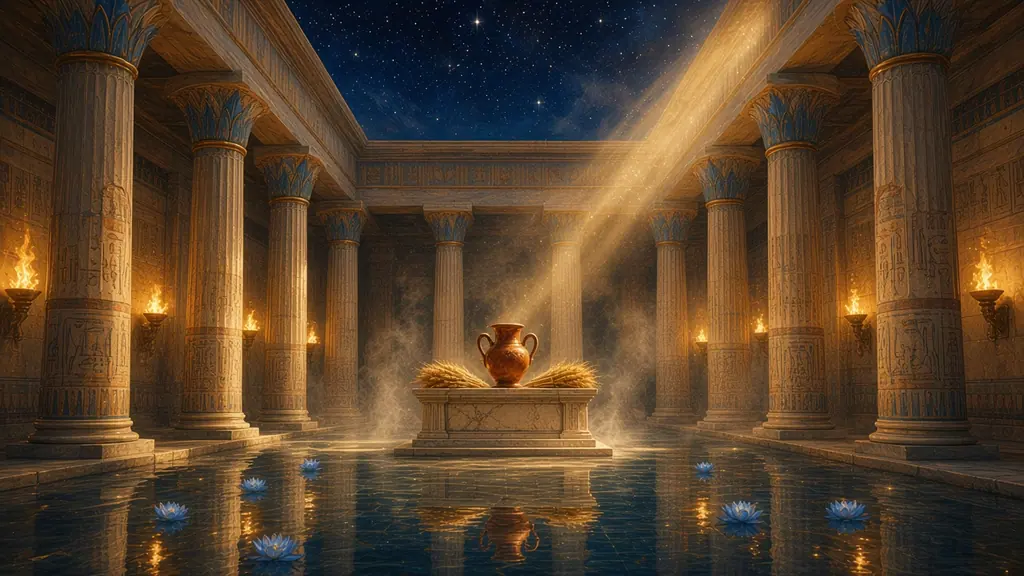
吗哪
完整页:吗哪。教会将其对圣礼的理解建立在祭司职分的事工上,以及它归于上帝吩咐利未家亚伦的一项托付:
“Gather the manna... distribute it to each man and woman and child according to their need.”
在出埃及记 16 章的圣经叙事中,吗哪是旷野中赐给以色列的天上的粮;各家收取 “every man according to his eating,” 并吩咐亚伦将一俄梅珥存 “before the LORD。”2
Kykeon 与厄琉息斯密仪
完整页:Kykeon 与麦角。数世纪间,直到公元四世纪末,雅典附近厄琉息斯的得墨忒耳与珀耳塞福涅密仪入会者,在仪式高潮前饮用称为 kykeon 的神圣大麦饮。3
有争议 在 The Road to Eleusis(1978)中,R. Gordon Wasson、化学家 Albert Hofmann(首次从麦角合成 LSD)与古典学家 Carl Ruck 提出 kykeon 含有生长在谷物上的麦角。3 Brian Muraresku 的 The Immortality Key(2020)将论证延伸至早期基督教中可能的迷幻酒。4 多数古典学家与历史学家并不接受任一命题为已证实。
Soma 与 haoma
完整页:Soma 与 haoma。《梨俱吠陀》用整卷赞美 Soma——压成圣饮并被赞为神的植物;其阿维斯塔对应物是琐罗亚斯德传统中的 haoma。5
有争议 该植物从未被确定鉴定。R. Gordon Wasson 主张毒蝇伞(1968);另有人主张麻黄;David Flattery 与 Martin Schwartz 在 Haoma and Harmaline(1989)中主张叙利亚芸香。5 另见毒蝇伞。
叙利亚芸香
完整页:叙利亚芸香。叙利亚芸香(Peganum harmala)分布于地中海至中亚。其种子含哈明与哈马林,至今仍在中东与中亚部分地区焚烧为香。6 哈马生物碱亦见于死藤水所用藤本。
蓝莲
完整页:蓝莲。尼罗河蓝色睡莲(Nymphaea caerulea)在古埃及艺术中反复出现,是太阳与重生的象征。7
有争议 埃及人是否在仪式中为效果而使用该花长期存在争论,因为证据多为图像。2024 年,Davide Tanasi 领导的团队报告在公元前二世纪托勒密埃及 Bes 瓶中发现蓝色睡莲与叙利亚芸香痕迹——化学证据表明该问题并非纯属推测。10
Iboga 与 Bwiti
完整页:Iboga。Iboga(Tabernanthe iboga)是中西部非洲雨林灌木。其含伊博格碱的根皮是 Bwiti 的圣礼;Bwiti 在加蓬实行——在那里被承认为国家官方宗教之一——中心仪式是以 iboga 入会。89 一些 Bwiti 社群已融入基督教元素。
问答
本页涵盖哪些古代圣礼?
吗哪、kykeon 与厄琉息斯、Soma 与 haoma、叙利亚芸香、蓝莲,以及 iboga/Bwiti——各有完整页链接。
麦角与 Soma 理论是否已证实?
否。Wasson/Hofmann/Ruck 关于 kykeon 以及关于 Soma 的主张仍有争议;多数古典学家不接受为已证实。
本页是否说明如何获取这些物质?
否。是历史与争论,并列于教会教导;不涉及获取或使用。
来源
- Official Lawful Notice — The Church of the Only Begotten Son
- Exodus 16, the manna in the wilderness (KJV) — Bible Gateway
- Kykeon — the drink of the Eleusinian Mysteries, with references
- Muraresku, The Immortality Key: The Secret History of the Religion with No Name (St. Martin’s Press, 2020)
- Soma (drink) — the identification debate, with references
- Peganum harmala (Syrian rue) — botany and history, with references
- Nymphaea caerulea (blue lotus) — botany and history, with references
- Bwiti — religion of Gabon, with references
- Tabernanthe iboga — botany and history, with references
- Tanasi et al., “Multianalytical investigation reveals psychotropic substances in a Ptolemaic Egyptian vase”, Scientific Reports 14 (2024) 27891
Scholarly claims about sacred plants in history are summarized with their sources, and contested claims are marked as contested. The church’s own beliefs are quoted exactly and linked to the page where they appear.