The church’s view
The church holds that the sacred substances of the earth were made by God — in the words of its Official Lawful Notice, “Plant, Herb, Mineral, Metal & Fungus.”1 The fly agaric is one of the fungi most often discussed in the history of sacred plants, and it sits at the center of the debate over mushrooms in Christian art that the church cites through Dr. Jerry B. Brown’s work.
Siberian ritual
Amanita muscaria, the fly agaric, grows across the temperate and boreal forests of the Northern Hemisphere. Its main active compounds are ibotenic acid and muscimol — chemically unrelated to psilocybin — and it is known as a poisonous mushroom.2 Travelers and ethnographers from the eighteenth century onward described its ritual use among peoples of Siberia, including the Koryak, and its use by shamans.2
The Soma debate
The Rig Veda praises Soma, a sacred drink pressed from a plant, as a god. In Soma: Divine Mushroom of Immortality (1968), R. Gordon Wasson argued that the plant was the fly agaric.3
Contested Wasson’s identification has never been settled. Other scholars have proposed ephedra, and David Flattery and Martin Schwartz argued in 1989 for Syrian rue (Peganum harmala); see Ancient sacraments.3
The Plaincourault fresco
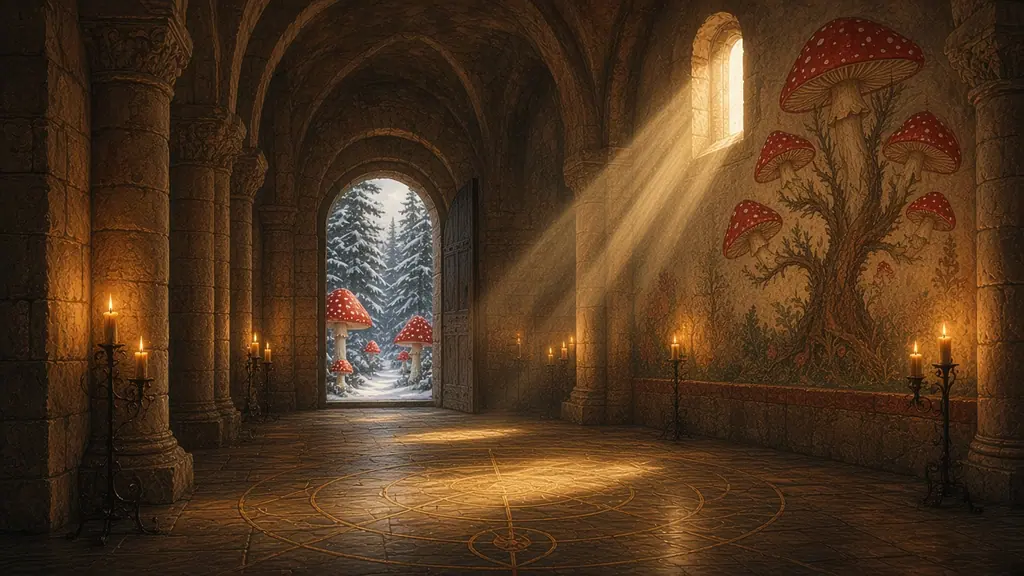
The chapel of Plaincourault, built in the twelfth century by the Knights Hospitaller at Mérigny in central France, preserves Romanesque frescoes.5 One shows Adam and Eve on either side of the Tree of Knowledge, with the serpent coiled in its branches. The tree resembles a branching red mushroom with white spots.
Contested In the twentieth century the image became a touchstone. Wasson, persuaded by the art historian Erwin Panofsky, held that medieval painters drew such trees as stylized pines. Jerry and Julie Brown, in The Psychedelic Gospels and a 2019 paper, argue that the painters meant the mushroom.46 The church recognizes the Browns’ book as revealing truths “hidden in plain sight for more than 500 years in the art that adorned and decorated the interiors of some of the first church buildings ever built.” Read the church’s statement in its Historical Foundations.
Questions and answers
Is Amanita muscaria the same as a psilocybin mushroom?
No. The fly agaric’s principal active compounds are ibotenic acid and muscimol, which are chemically unrelated to psilocybin. It is also known as a poisonous mushroom.
Was Soma the fly agaric?
R. Gordon Wasson argued so in 1968. Other scholars have proposed ephedra or Syrian rue instead. The identity of Soma is unresolved and contested.
What is the Plaincourault fresco?
A thirteenth-century painting of Adam, Eve and the serpent in the chapel of Plaincourault in central France. Its Tree of Knowledge looks like a branching red mushroom. Whether that was intended is debated.
Sources
- Official Lawful Notice — The Church of the Only Begotten Son
- Fly agaric (Amanita muscaria) — Encyclopaedia Britannica
- Soma (drink) — the identification debate, with references
- Brown & Brown, “Entheogens in Christian art: Wasson, Allegro, and the Psychedelic Gospels”, Journal of Psychedelic Studies 3:2 (2019) 142–163
- Plaincourault Chapel, Mérigny, Indre — history and frescoes
- Brown & Brown, The Psychedelic Gospels (Park Street Press, 2016)
Scholarly claims about sacred plants in history are summarized with their sources, and contested claims are marked as contested. The church’s own beliefs are quoted exactly and linked to the page where they appear.